
F1's August Reckoning: The Engine U-Turn, the $127M Distribution Dip, and the Verstappen Domino

FORMULA 1 · IMPACT ANALYSIS & OPINION · SUMMER BREAK BRIEFING
F1’s August Reckoning: The Engine U-Turn, the $127M Distribution Dip, and the Verstappen Domino
Five stories entered the shutdown window — a Hungarian Grand Prix result, a mid-season power-unit rebalance, a revenue swing at Liberty Media, a $215M cost cap, and an open driver market. Read together, they are one governance stress test for a $3.9B listed asset.
When a central bank rewrites its monetary framework eighteen months into a cycle, bond traders do not merely reprice the assets; they reprice the institution. Formula 1 has just executed that manoeuvre on its own rulebook. In a single shutdown window the sport’s governing body conceded a mid-season rebalance of the 50:50 combustion-electrical split defining the 2026 power unit, the rights holder posted a 38 per cent quarterly revenue contraction, and the grid’s most valuable asset entered the transfer window without a contract for next year. None of the five stories below is a crisis in isolation. Together they constitute a single governance stress test for a sport that now behaves like a listed financial product.
The Summer Break Docket
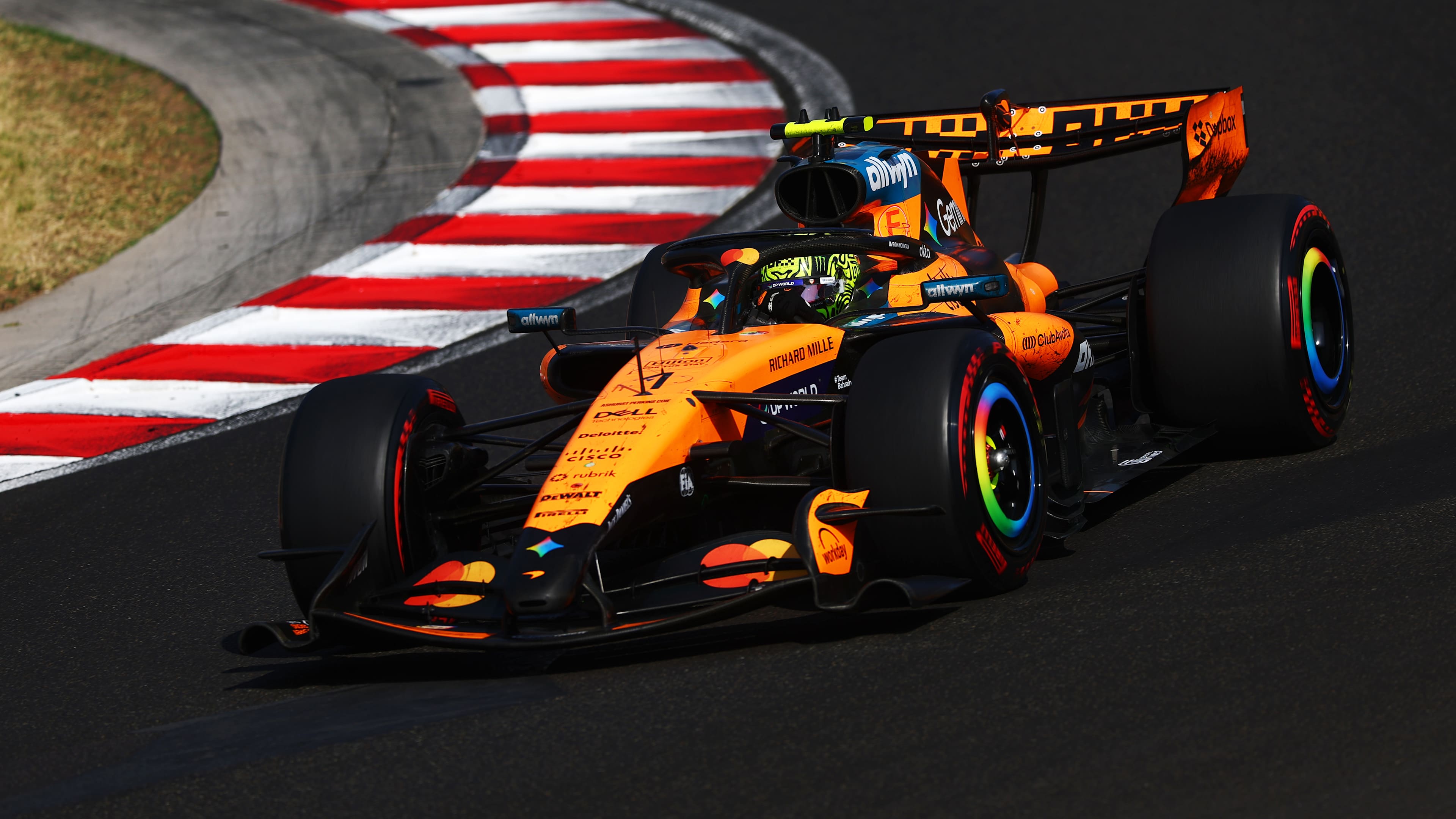
Eleven rounds into the new cycle, Lando Norris converted pole at the Hungaroring into his and McLaren’s first victory of the season, while Kimi Antonelli’s podium extended his title lead to 50 points over Lewis Hamilton on the same weekend the FIA — facing Max Verstappen’s exit threat and Fernando Alonso labelling the formula the “battery world championship” — agreed to reweight the internal-combustion-to-electrical ratio of the 2026 power units. Layer onto that Liberty Media’s filings, which show team distributions down roughly $127M in the first half against a cost cap that has jumped from $135M to $215M, an 11th team in Cadillac still qualifying on the back row, and a 2027 driver market in which 17 seats were open at the season’s start, with Verstappen holding the domino that decides them all.
Echoes of 2014: Energy Resets Are Never Neutral
The last time Formula 1 rewrote its energy formula, the lesson was brutal and durable: initial calibration determines the decade’s outcome. The 2014 turbo-hybrid reset did not produce convergence; it produced eight consecutive constructors’ titles for Mercedes, because the party that read the energy split best in year one collected the dividend for the rest of the cycle. The FIA has governed mid-season at the edges before — the 2019 engine-mapping clarifications and the 2021 flexible-wing technical directive are on the record — but those were peripheral adjustments, not a reweighting of the formula’s core physics in its first year.
That distinction is the entire analytical ballgame. A marginal directive is maintenance; a mid-cycle rebalance of the combustion-electrical ratio is an admission that the ratio was mispriced at the drafting stage. The 2009 double-diffuser episode supplies the second lesson: wherever the rulebook is ambiguous, the best-resourced teams arbitrage it, and the arbitration becomes the championship. What 2026 inherits from both precedents is their combined risk profile — dynastic competitive distortion on one flank, a governance credibility discount on the other.
The Invisible Ledger: What the Paddock Press Room Missed
The first underpriced variable is the OEM risk premium. The 2026 rulebook was Formula 1’s prospectus for manufacturer capital: it is the document that brought Audi in as a works entrant, placed General Motors’ Cadillac on the grid as the 11th team, and put Honda back on Red Bull’s engine cover. A formula whose defining ratio can move in August inserts a regulatory risk premium into every future OEM negotiation. When the energy split is negotiable, the next manufacturer’s board will demand a steeper discount on entry, partnership guarantees and cost-cap headroom — and at a $215M cap, teams can no longer absorb that difference internally. The correction’s price will be paid, in other words, not in lap time but in the grid’s cost of capital.
The second is the asymmetric shock to team valuations. A $127M first-half erosion in distributions lands on a grid where the bottom half operates on thin margins, and it lands precisely when the newest franchise burns the most cash: Cadillac qualified last at the Hungaroring and retired both cars on race day. Under the current Concorde architecture, prize money is the operating lifeline for positions seven through eleven; even a phasing-driven dip compresses mid-grid enterprise values for two to three reporting cycles. Expect distressed-asset behaviour by Q4 — minority equity stakes, sale-leasebacks on facilities, below-market sponsorship inventory — and expect stronger balance sheets to shop that market.
The third is a compounding credibility discount on the product itself. A 0.1 km/h pit-lane infringement that dropped Hamilton to P5, grid penalties that rearranged both title contenders’ races, and a technical U-turn on the power unit all landed within the same fortnight. Consistency of rule application is the underlying asset of a broadcast product that generated $3.9B in revenue last year; when the technical rulebook and the stewards’ room both read as discretionary inside one news cycle, the sport risks not a single controversy but a slow erosion of competitive-integrity perception — the precise metric that keeps 310,000 people at the Hungaroring and 6.75M attendees across the season paying premium prices.
The Other Ledger: Phasing, Not Collapse
The bear case, however, requires its own correction. Liberty Media’s Q2 filing attributes the 38 per cent contraction — revenue of $764M against $1.226B a year earlier — to calendar phasing, with four fewer races held in the quarter, against a Q1 in which revenue rose 53 per cent to $617M on the back of a full-year 2025 that grew 14 per cent with attendance up 4 per cent to 6.75M. The distribution dip is a recognition-timing artefact, not a demand collapse, and the back half carries twelve races. The cost-cap step to $215M is likewise largely pass-through accounting for a longer calendar and new power-unit scope, not evidence of runaway spend.
Calibration, Not Capitulation
Nor is the power-unit adjustment proof of regulatory failure. The electrified split is the very clause that signed Audi, General Motors and Honda, and the FIA’s stated intent — “to address issues related to energy management and fuel energy flow characteristics and make qualifying more flat-out” without harming the racing — is product calibration, not retreat. Revising the ratio in year one of a five-year cycle is materially cheaper than entrenching a flawed formula until 2030, which is precisely what the sport did between 2014 and 2020. The governance failure would have been silence.
Positioning for the Back Half: A Playbook
- Hospitality operators, Zandvoort–Monza–Madrid corridor: price for volatility. A three-horse title fight historically lifts walk-up demand, but staff to dynamic-pricing triggers, not to a single sell-out assumption.
- Bars, broadcasters, second-screen operators: programme around the Antonelli–Hamilton–Russell fight and the Verstappen saga; the back half of 2026 is the densest viewing slate since 2021.
- Merchandisers and ticket resellers: treat seat-change rumours as short-dated volatility — spike inventory, no long positions.
- Investors and municipal promoters: compressed mid-grid valuations through Q4 are an entry window for minority equity; index hosting-fee clauses against further cost-cap pass-through.
The February 2027 Grid
Six months out, the most probable landscape is this: Antonelli closes 2026 as champion, but with the power-unit directive converging outputs, the Mercedes–Ferrari delta halves by Abu Dhabi. Verstappen’s decision — forced by October — triggers the 2027 cascade: Sainz settles at Audi, Pérez resurfaces at Williams, Alonso’s exit tour is formalised. The FIA quietly institutionalises a standing power-unit equalisation protocol, a de facto balance of performance for hybrids, and Liberty returns to double-digit full-year growth as the twelve-race back half books in. At least one franchise enters a cost-cap compliance review before December. The grid will still field 22 cars in 2027; the shift is in the economic centre of gravity — away from the spectacle of the new rules and toward the institutions that govern them.
Related Articles

The Valuation Fracture: How the NBA's New Media Rights Era is Rewriting the Basketball Power Hierarchy
Sep 25, 2026
The Telemetry Ticker: How the Active Aero Mandate is Converting Formula 1 into a Tradable Algorithmic Asset Class
Sep 25, 2026
Comments (0)
No comments yet. Be the first to share your thoughts!
Want to join the discussion?
Please log in to post a comment.
Login NoworCreate an Account