
Record Towers, Idle Cranes: Inside the Music Industry's Barbell Economy

The music economy now behaves like a major city’s real-estate market. Trophy towers trade at record prices, cranes have vanished from the mid-market, and a new class of modular construction — machine-generated supply — has just been legalized in settlements with the old landlords. The week of Aug. 12, 2026 delivered the most complete survey of that market yet, and the read-through is uncomfortable for anyone earning a living in the middle of the business.
Five Filings From a Barbell Economy
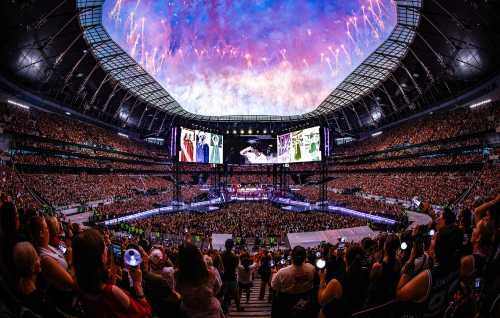
BTS rolls into four nights at SoFi Stadium on a 79-date world tour and Taylor Swift becomes the youngest inductee into the Nashville Songwriters Hall of Fame, while Live Nation posts USD 7.7 billion in quarterly revenue even as the average North American gross per show falls 7.8 percent, the three major labels convert their AI copyright lawsuits into licensing contracts, and TikTok Music shuts down, laying off its entire staff. These are not five stories; they are one: capital is concentrating at the top of the business and in the machine layer beneath it, while the professional middle compresses between the two.
The Hollowed Middle of the Road
The first under-reported implication sits in touring’s yield curve. Record volume with declining per-unit yield describes a market adding supply faster than demand at every tier below the stadium. The practical consequence is a routing squeeze: clubs and theatres lose dates to festivals and arena residencies, mid-tier acts accept support slots they would have refused in 2024, and the development ladder that converts local audiences into headline buyers loses its rungs — the same dynamic that hollowed recorded music’s middle class after 2000, now applied to the stage.
Supply Expansion Is Not Recession
The bear case on touring carries a credible rebuttal. A falling per-show average is partly mechanical — more dates on routings dilute the mean — and 49 million attendees in one quarter is breadth, not fatigue. Service fees, near 29 percent of face value on major tours per Chartlex’s 2026 data, finance production in an inflationary cost environment, and dynamic pricing recaptures rents that once flowed to scalpers. With the FTC’s all-in pricing rule exposing true cost at checkout, demand has not weakened so much as been priced more efficiently.
The Catalog Becomes a Dual-Use Asset
The second implication is capital-structural. With UMG–Udio, WMG–Suno and Sony–KLAY agreements in force, a master recording is now a dual-use asset: a royalty stream and a training corpus, each priced separately. That is why the same week’s Hall of Fame induction matters beyond ceremony — it publicly defines the industry’s scarce asset as the song, not the record, at the exact moment the song acquires a second buyer. The distribution of the new revenue, however, is already contested.
“These licensing agreements present a real risk that major labels will replicate the licensing model of streaming in AI music services, undervaluing song rights.” — European Composer and Songwriter Alliance (ECSA)
If the pro-rata waterfall is replicated in machine licensing, the second royalty stack will concentrate exactly where the first did: at the top of the balance sheet, far from the writer.
Licensing Is a Price, Not a Betrayal
The betrayal critique understates the alternative. Warner Music CEO Robert Kyncl made artist opt-in a “non-negotiable,” preserving consent at the individual level, and a licensed market converts a fair-use defense — which would have paid creators nothing through a decade of litigation — into a compensated use. “We’re making a new market here,” Udio’s chief executive told Billboard of the UMG pact, and markets, whatever their flaws, price things. The settlements also legalize creation tools for artists previously locked out of production, including disabled creators. A flawed royalty stream can be renegotiated; a successful fair-use precedent cannot.
The Napster Playbook, Played in Reverse
The industry has litigated this shape before. Labels sued Napster in 2000, then licensed iTunes in 2003 and Spotify in 2011 — and each settlement anchored the next format’s economics for a decade: Apple’s 99-cent price point, Spotify’s pro-rata pool. The lesson is not that litigation failed; it is that the party controlling the format sets the anchor, and rights holders’ courtroom victories became negotiating-table discounts. The 1940s add a second warning: when ASCAP’s catalog priced too high, broadcasters built BMI as a parallel supply chain. The read-through for AI is exact — opt-in gaps and opaque rates will not stop machine supply; they will route around it.
Discovery Is the New Scarcity
The third implication sits at the top of the funnel. TikTok Music’s shutdown removed one of the few discovery layers operating outside the streaming incumbents, concentrating marketing dependence on the remaining platforms just as AI-assisted curation scales. Release economics shift accordingly: breaking a new act becomes a line item in someone else’s platform budget, and patronage stop-gaps — Kickstarter’s USD 1 million artist fund among them — fill the vacuum. When discovery consolidates, the industry’s already-rising cost of breaking artists becomes a toll.
February 2027: The First Training Statements
Six months out, expect the AI accords to produce their first accounting — and their first disputes. Training-royalty statements will land with Q4 2026 cycles, and opt-in participation rates will become the most-watched disclosed metric in the business; at least one major publisher, under ECSA-style pressure, will demand separate song-rights terms. Spotify’s August labeling system will harden into a de facto industry standard and an EU regulatory reference point. On the road, mid-tier routing will consolidate into fewer, larger stops, and face-value exchanges will become the default primary mechanism for stadium tours on the BTS model. Catalog acquisition agreements will begin citing “training rights included” as a standard representation — and the first lawsuit testing its scope will be filed before spring.
What Main Street and the Working Musician Should Do Now
- Indie venues and promoters: book the hollowed middle now; agents chasing yield on mid-tier routing will accept terms refused in 2024. Lock 2027 dates this quarter and bundle local openers into festival slots.
- Working musicians: audit every contract for AI and opt-in language before signature; register works with your PRO and the Mechanical Licensing Collective so training royalties can find you; reject catalog buyouts priced before the training-rate market matures.
- Consumers: compare all-in prices under the FTC rule and use official face-value exchanges; on stadium tours the cheapest legal seat is now the presale, not the resale market.
- City businesses: treat stadium weekends — BTS’s September SoFi run above all — as surge events with dynamic staffing and transit and F&B partnerships, because live spend is the tier of this economy still compounding.
The towers are full and the cranes are idle. The question for the next two contract cycles is whether the middle of the business gets built back — or whether the modular supply arrives first.
Related Articles

The Architecture of Audio Securitization: How AI Arbitrage, Antitrust Unbundling, and Catalog Financialization are Dismantling the Legacy Music Economy
Sep 25, 2026
The Aeolian Moment: How the Synthetic Vocal License is Forcing the Great Music Industry Metadata Reset
Sep 25, 2026
Comments (0)
No comments yet. Be the first to share your thoughts!
Want to join the discussion?
Please log in to post a comment.
Login NoworCreate an Account