
WHO-UNICEF Report: Global Childhood Immunization Shows Fragile Recovery as 13.5 Million Children Remain Unvaccinated

GENEVA — In a concurrent announcement today, the World Health Organization (WHO) and the United Nations Children's Fund (UNICEF) released their annual Estimates of National Immunization Coverage (WUENIC) for 2025, revealing a tentative recovery in global childhood vaccination rates tempered by stubborn challenges that leave millions of children vulnerable to avoidable diseases.
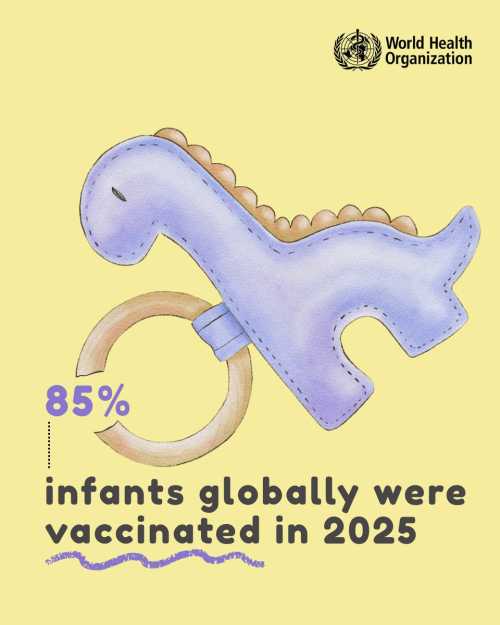
Key Findings: In 2025, 90% of infants globally—approximately 116 million children—received at least one dose of the diphtheria, tetanus, and pertussis (DTP) vaccine, while 85% (110 million) completed the full three-dose series. Both indicators rose by one percentage point from the previous year, though global coverage remains one point below 2019 pre-pandemic levels.
The data reveals that an estimated 13.5 million zero-dose children did not receive a single vaccine in their first year during 2025. While this represents nearly 750,000 fewer children than the previous year, this progress is counterbalanced by a disturbing rise in children who begin the vaccination schedule but fail to complete it.
Globally, 7.3 million infants received their first DTP dose but dropped out before receiving their first measles dose. This attrition rate has contributed to stalled measles coverage, with only 84% of children receiving the first measles dose (MCV1) and 77% receiving the second dose (MCV2)—both figures falling substantially short of the 95% threshold required to prevent outbreaks of this highly contagious virus. Consequently, 57 countries reported large or disruptive measles outbreaks in 2025.
Critical Statistics:
- 13.5 million zero-dose children (received no vaccines)
- 7.3 million infants dropped out before completing vaccination schedule
- 57 countries experienced large measles outbreaks
- 100 countries maintained at least 90% DTP3 coverage since 2019
- 65 countries stagnating or falling behind on immunization
"Governments and health workers have helped global vaccination rates bounce back after dropping significantly during the COVID-19 pandemic," said UNICEF Executive Director Catherine Russell. "But millions of vulnerable children are still being left unprotected due to conflict, displacement, and poverty. We must reach every child, and we must rebuild trust where it is fraying. No child should suffer from a disease that a simple vaccine can prevent."
The report's geographic analysis reveals divergent regional trajectories. Compared to their 2019 baselines, the Americas and South-East Asia have fully recovered and improved their performance, with South-East Asia now the highest-performing region. While Africa, the Eastern Mediterranean, and Europe regions saw gains last year, their coverage remains below pre-pandemic levels. By contrast, the Western Pacific experienced a decline, leaving it the region furthest below its 2019 baseline.
More than half of all zero-dose children live in fragile, conflict-affected, or vulnerable (FCV) settings, even though these areas account for only about a third of the world's child population. In these settings, immunization programs are often strained by political upheaval, insecurity, or chronic underfunding. For example, in a single year, Syria lost 6 percentage points on DTP1 coverage and 12 points on MCV1. However, Sudan recorded the largest single-country gain globally last year, increasing DTP1 coverage by 35 percentage points and lifting MCV1 coverage by 22 points, demonstrating what is possible when access to services improves even amid ongoing conflict.
In middle- and high-income countries, even where vaccines are fully accessible, coverage is slipping amid shifting political commitment, structural challenges, or rising hesitancy. South Africa's DTP1 coverage has fallen 20 percentage points since 2019 and continued to decline in 2025. After the largest increase in MCV1 coverage in the region in 2024, Bosnia and Herzegovina saw a 23-point drop in the past year.
Official Statements:"Every child, whether born into wealth or poverty, peace or conflict, deserves the lifegiving protection that vaccines provide. Immunization is one of the most cost-effective, most equitable, and most reliable interventions for protecting children's health and well-being," said Dr. Tedros Adhanom Ghebreyesus, WHO Director-General. "Our greatest security begins with ensuring that everyone, wherever they may live, is protected from deadly diseases that vaccines have the power to prevent."
WHO and UNICEF are working with Gavi, the Vaccine Alliance, and other partners to deliver the global Immunization Agenda 2030 (IA2030) goal to ensure vaccines reach everyone, everywhere, at every age. Yet the world remains off track to reach the global target of reducing zero-dose children.
To make this sharp course correction and bridge the critical gap, WHO and UNICEF call on governments and relevant partners to:
- Strengthen immunization in conflict and fragile settings to reach and retain children
- Counter false and misleading health information and fully support vaccine uptake acceleration
- Increase and sustain domestic and global funding for immunization programs and partnerships, including Gavi
- Invest in stronger data and disease surveillance systems to drive and guide high-impact immunization program strengthening efforts
Follow the Conversation:???? UNICEF on X/Twitter WHO SEARO on X/Twitter Full WHO Report
The release of these findings comes at a pivotal moment for global health, as the international community grapples with the aftermath of the COVID-19 pandemic and seeks to rebuild and strengthen immunization systems that serve as the foundation of primary health care for the world's most vulnerable children.
Related Articles

The Biological Bottleneck: How Genomic Sovereignty, In Vivo Editing, and Algorithmic Epidemiology Are Restructuring Global Health Economics
Oct 15, 2026
The Biometric Panopticon: How Continuous Surveillance and AMR are Obliterating the Legacy Public Health Paradigm
Oct 15, 2026
Comments (0)
No comments yet. Be the first to share your thoughts!
Want to join the discussion?
Please log in to post a comment.
Login NoworCreate an Account