
Entertainment's Perfect Storm: Five Stories Reshaping Hollywood and Sports Forever

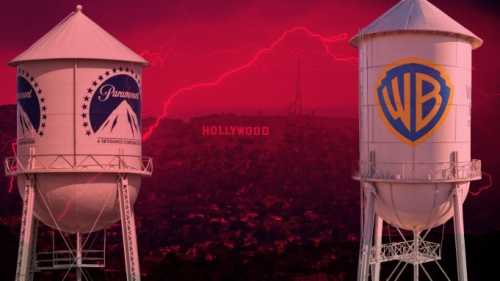
Like a row of dominoes toppling in rapid succession, this week's entertainment landscape collapsed and reformed simultaneously across five critical fault lines—from the courtroom battles over AI-generated music to billion-dollar media mergers, from plagiarism accusations to historic athlete migrations. These aren't isolated incidents; they're interconnected tremors signaling a fundamental restructuring of how creative content is valued, protected, and monetized in 2026.
The Great Consolidation: Paramount-WBD Merger Clears Final Hurdle
Paramount Skydance reached a settlement Monday with twelve state attorneys general, removing the last major obstacle to the $111 billion Warner Bros. Discovery merger [[60]]. The deal keeps Paramount's Los Angeles headquarters intact and establishes editorial independence boards for CNN and CBS News [[60]][[58]].
The Unseen Implications: This isn't merely corporate reshuffling—it's survival arithmetic. Within months of closing the Skydance merger, Paramount cut approximately 2,000 jobs, roughly 10% of its workforce [[112]]. The merged entity will control one of the industry's most formidable content libraries, but faces an existential threat: Netflix's equity value of $528 billion exceeds all other major media companies and theatrical exhibitors combined [[118]].
Industry analysts warn that the merger reduces the number of diversified, large-scale competitors operating across film production and content licensing [[114]]. Yet proponents argue consolidation strengthens Hollywood against streaming platform dominance [[113]]. The settlement includes court-enforceable commitments for increased film production and an additional $1.5 billion infusion into domestic filmmaking [[58]].
Counter-Argument: Critics point to Yale Insights analysis showing that history provides no comfort—previous mega-mergers in entertainment have consistently resulted in reduced creative output, workforce reductions, and higher consumer prices without proportional quality improvements [[112]]. The promise of "more films" rings hollow when paired with simultaneous job eliminations.
AI Music Wars Escalate: UMG's DistroKid Lawsuit
Universal Music Group filed suit against DistroKid on September 15, accusing the distribution service of "flooding streaming platforms with AI-generated slop" and engaging in deceptive trade practices and copyright infringement [[49]][[52]]. The lawsuit alleges DistroKid systematically enables mass uploads of AI-generated tracks that divert royalties from human artists.
The Financial Stakes: US copyright law sets damages for willful infringement at up to $150,000 per work [[8]]. At that ceiling, the 60,202 recordings listed in parallel Suno lawsuits would carry a theoretical maximum exceeding $9 billion [[8]]. More than 1,800 artists are supporting related class-action lawsuits against AI music platforms [[82]].
"2026 will harden the industry's battle lines: artists versus rightsholders over training-data infringement, artistic autonomy and freedom," according to copyright analysis published in LinkedIn [[81]]. The lawsuit zeroes in on allegations that DistroKid operates an "AI-slop pipeline" that undermines the economic foundation of professional music creation [[55]].
Expert Perspective: "The potential damages? Up to $150,000 per infringed track," notes intellectual property attorney analysis [[94]]. Streaming platforms have responded with varying policies—Bandcamp implemented a full ban on AI-produced music, while Spotify treats AI-generated content with minimal human involvement as low-value content subject to removal [[105]][[108]].
LeBron's Philadelphia Gamble: Economics Over Ego
LeBron James signed a two-year, $8 million deal with the Philadelphia 76ers, including a player option, according to Klutch Sports Group CEO Rich Paul [[72]][[78]]. The 41-year-old superstar accepted the veteran minimum salary—less than his rookie contract in 2003-04—to join forces with Joel Embiid and Tyrese Maxey [[79]].
Strategic Analysis: This represents more than altruistic team-building. The NBA salary cap for 2026-27 sits at $164.961 million [[96]], and James's reduced salary provides Philadelphia crucial roster flexibility. The Sixers were projected approximately $18 million below the cap, making James's minimum contract a strategic masterstroke [[98]].
James aims to break Philadelphia's 43-year championship drought, mirroring his 2016 Cleveland Cavaliers championship that ended the city's 52-year title famine [[72]]. However, this move carries significant risk: at 41, joining a contender rather than building one represents a calculated bet on legacy over control.
Counter-Argument: Veteran NBA contracts in 2026-27 minimum scale reach $2,449,421 for players with James's experience [[101]]. While nominally a "pay cut," this structure allows the 76ers to maximize their roster under the league's punishing salary cap, which can quickly turn a $180 million roster into a $300 million bill when veteran extensions activate [[100]].
Taylor Swift's Directorial Coronation
MTV announced Taylor Swift will receive the inaugural Artist Director Honors at the 2026 Video Music Awards, recognizing "a sustained and influential body of work from artists who have pushed creative boundaries and developed a clear directorial voice" [[66]][[69]]. Swift becomes the most awarded artist in VMA history with this honor.
Cultural Significance: This award transcends typical industry recognition. Swift has won four VMAs for Best Direction and received seven nominations in the category [[71]]. The creation of this award category itself signals MTV's acknowledgment that artists now function as complete creative auteurs—controlling narrative, visual aesthetic, and commercial strategy.
The timing proves strategic: Swift's directorial work on her music videos has evolved from performance documentation to cinematic storytelling, influencing a generation of artists to claim creative control. Madonna leads the 2026 VMAs with 11 nominations, setting up a symbolic passing-of-the-torch moment [[68]].
Plagiarism in the Digital Age: Miley Cyrus and Amanda Lear
French disco diva Amanda Lear publicly accused Miley Cyrus on September 21 of plagiarizing her 1978 song "The Sphinx" in Cyrus's new track "REDLIGHTS" from the album Bass Persuades [[43]][[48]]. Lear, a model-turned-singer from the 1970s disco era, was alerted to similarities by fans and brought the matter to her producer and record label [[42]].
Broader Context: This accusation arrives amid heightened scrutiny of musical originality. Piracy sites receive over 215 billion visits per year globally, while stream-ripping affects 29% of all listeners according to IFPI [[86]]. The music industry now faces 87 active copyright suits against AI companies alone [[87]].
Historical precedent suggests such claims follow predictable patterns: initial social media amplification, forensic musicological analysis, then legal maneuvering. The outcome depends on demonstrating "substantial similarity"—a legal standard that has bankrupted lesser artists while major labels negotiate confidential settlements.
Six-Month Forecast: The New Entertainment Paradigm
By March 2027, expect: (1) The Paramount-WBD merger to trigger at least two additional major media consolidations as competitors scramble for scale; (2) AI music litigation to produce the first landmark ruling establishing training data compensation frameworks; (3) Streaming platforms to implement mandatory AI-content labeling systems; (4) Veteran athlete minimum contracts to become a dominant roster-construction strategy across the NBA; (5) Artist-director recognition to become standard awards show categorization, fundamentally changing how we define musical authorship.
The entertainment industry isn't adapting to disruption—it's being rewritten at the source code level. Those who control the means of production, distribution, and legal protection will determine the next decade's cultural landscape.
Related Articles

The $67 Billion Mirage: When Sports and Entertainment Spectacle Outpaces Sustainability
Sep 21, 2026
The Infrastructure Takeover: How Athletes and Hollywood Are Rewiring Sports Media
Sep 18, 2026
Comments (0)
No comments yet. Be the first to share your thoughts!
Want to join the discussion?
Please log in to post a comment.
Login NoworCreate an Account