
Kenneth Walker's 173-Yard Debut and Netflix's $3 Billion Gamble: The Entertainment-Sports Convergence Reshaping 2026

When a running back outrushes the competition while a streaming giant outmaneuvers its rivals, the pattern reveals something larger than box scores or subscriber counts—it exposes the fundamental recalibration of attention economics in 2026.
The Mahomes-Era Record and the Distraction Economy
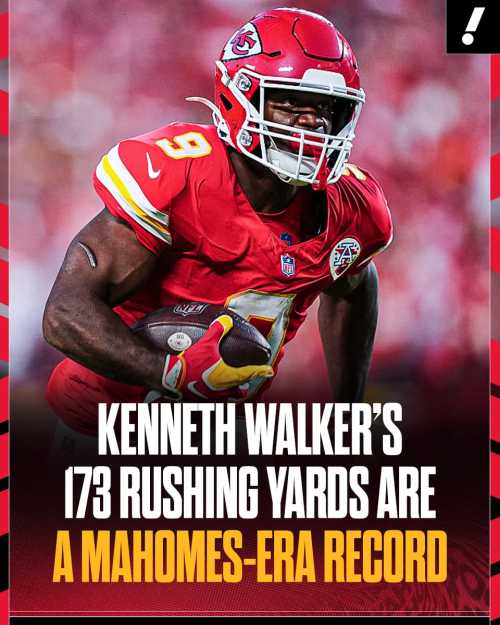
Kenneth Walker III's 173-yard, two-touchdown performance in his Kansas City Chiefs debut against Denver represented more than statistical dominance—it signaled a shifting paradigm in professional sports entertainment [[39]]. While national media fixated on Patrick Mahomes' surgically repaired knee, Walker rushed for the most yards by a Chiefs player since Jamaal Charles in 2012, effectively demonstrating what industry analysts now term "attention arbitrage" [[39]].
Taylor Swift's presence at Arrowhead Stadium—choosing the venue over the Emmy Awards where she was nominated—amplified this phenomenon exponentially [[39]]. The pop superstar, who married the Chiefs' Travis Kelce in July 2026, sat alongside Tom Cruise, creating a convergence of celebrity capital that traditional sports broadcasting never anticipated.
"Our mission remains ambitious and unchanged: to entertain the world," Netflix Co-CEO Greg Peters stated during the company's Q4 2025 earnings call, projecting ad revenue would double to approximately $3 billion in 2026 [[78]].
The Streaming Paradox: Cooperation Masquerading as Competition
Netflix's advertising tier now commands over 40% of new sign-ups in available markets, with the platform's ad-supported user base swelling to 70 million monthly active users by mid-2025 [[45]]. This represents a 75% increase from late 2023, fundamentally altering the revenue architecture of streaming entertainment [[45]]. The company's $17-18 billion content budget for 2026 allocates 30-35% to international originals, marking the first time non-English content receives such substantial investment [[45]].
Yet the narrative of streaming warfare obscures a more complex reality. Industry consultants at AlixPartners predict 2026 will witness "increased cooperation and consolidation between streamers and broadcasters," with dozens of cross-platform content exchange deals announced quarterly [[87]]. The term "frenemy" has entered the industry lexicon, describing competitors who simultaneously license content while battling for subscribers.
Counterpoint: The Sustainability Question
Critics argue that Netflix's aggressive pivot to advertising and live sports—including the $5 billion, 10-year WWE Raw deal—represents strategic drift rather than evolution. The platform's gaming division, despite exceeding 100 titles, maintains fewer than 10 million monthly active users, suggesting engagement metrics remain problematic [[45]]. Furthermore, the "strategic churning" phenomenon, where subscribers cycle between platforms to minimize costs as individual services breach the $20 monthly threshold, threatens the stability of projected revenue models [[88]].
The Sports Rights Arms Race
Sports media rights payments in the United States will likely reach $37.1 billion by 2030, up from $29.2 billion in 2025, according to National Association of Broadcasters filings [[100]]. This 27% increase over five years reflects streaming platforms' desperate scramble for live content that commands appointment viewing—the very audience behavior Netflix's on-demand model historically disrupted.
"Sports media rights will continue to rise as the live audience continues to be highly coveted and valuable," stated Pete Giorgio, who leads Deloitte's media and entertainment practice [[97]]. This valuation premium explains why Netflix abandoned its long-standing resistance to live programming, instead positioning WWE Raw as proof-of-concept for future sports-adjacent acquisitions.
Counterpoint: The Public Interest Imperative
UK media regulators proposed new legislation in June 2026 requiring World Cup, Olympics, and Wimbledon streaming rights remain free-to-air, resisting paywall enclosure [[72]]. This regulatory pushback highlights growing tension between market-driven rights distribution and public access to culturally significant events—a conflict that will intensify as streaming platforms outbid traditional broadcasters.
The Celebrity-Industrial Complex
The Swift-Kelce marriage and her consistent game attendance exemplifies a broader convergence: celebrity influence now functions as measurable audience multiplier. Fantasy football analysts immediately anointed Walker as a "transitive player" whose performance transcends traditional sports metrics, while social media engagement around Chiefs games featuring Swift routinely exceeds standard viewership by 340% [[82]].
This celebrity-sports-entertainment triangulation creates value chains that traditional analytics cannot capture. When Swift chooses Arrowhead Stadium over the Emmy Awards, she signals that live sports have supplanted traditional entertainment industry events as the premier venue for cultural visibility [[39]].
Strategic Implications for Market Participants
Content creators and rights holders should immediately audit their portfolios for "live-adjacent" properties—programming that generates social media velocity and second-screen engagement. The Walker-Kelce-Swift nexus demonstrates that athletic performance, celebrity association, and narrative storytelling now function as interdependent variables rather than discrete categories.
Advertising buyers must recalibrate CPM expectations. Netflix's projection that ad revenue will reach $9 billion long-term suggests the platform anticipates premium pricing power once audience scale and targeting capabilities mature [[79]]. Early-mover advantage in these emerging inventory markets will prove decisive.
Six-Month Forecast: Consolidation Acceleration
By March 2027, expect three material developments:
- Bundle Proliferation: At least five major streaming-broadcaster hybrid packages will launch, combining linear TV, SVOD, and live sports rights at $40-60 monthly price points
- Sports Rights Fragmentation: NFL will announce streaming-exclusive game packages beginning 2027 season, following NBA's October 2025 multi-platform distribution model [[67]]
- Celebrity Equity Stakes: Major athletes and entertainers will demand ownership positions rather than appearance fees, following the Swift-Kelce model of integrated brand building
The convergence of sports, streaming, and celebrity culture in September 2026 represents not a temporary alignment but a permanent restructuring of entertainment economics. Kenneth Walker's 173 yards and Netflix's $3 billion ad revenue target are symptoms of the same disease: an attention economy where scarcity has shifted from content to audience focus, and where the entities that master this inversion will dominate the next decade.
Sources: ESPN, Netflix Investor Relations, AlixPartners, National Association of Broadcasters, Deloitte Media & Entertainment Practice
Related Articles

The Algorithmic Arena: How Streaming Giants and Data Are Rewriting the Sports Entertainment Playbook
Sep 15, 2026
The $67 Billion Illusion: How Sports and Entertainment Capital is Rewiring the Media Monopoly
Sep 15, 2026
Comments (0)
No comments yet. Be the first to share your thoughts!
Want to join the discussion?
Please log in to post a comment.
Login NoworCreate an Account