
The Attention Squeeze: How a 25-Day Awards Gauntlet and the World Cup's $11 Billion Bill Are Repricing the Events Economy

When three weddings land in one small town on the same weekend, the bakery does not triple its revenue. It runs out of flour, the hotel raises rates until half the guests stay in the next county, and the second ceremony gets the band the first one declined. September 2026 is that weekend for the global attention economy.
Between Sept. 2 and Sept. 27, the 83rd Venice Film Festival, the 78th Primetime Emmy Awards and the 2026 MTV Video Music Awards will compress the entire awards-season launch window into 25 days, arriving exactly as FIFA's 16 host cities audit a tournament that left the governing body nearly $11 billion richer while stadium tours keep printing box-office records that defy every scarcity model on the books.
The $11 Billion Question
Start with the money that did not land locally. FIFA's 2026 cycle is the most lucrative in its history — roughly $11 billion in broadcasting, ticketing and commercial revenue — and as sport-management scholars writing in The Conversation observe, "sport economists have long demonstrated that mega-sport events' economic impacts such as the World Cup and Olympic Games cannot offset the substantial expenditures incurred by host cities." Yet the demand shock was real where it counts: Forbes' analysis of card data found purchases in host cities up 6.3 percent year over year, driven by a 16.7 percent jump in non-local spend. The unseen implication for the events industry is structural: mega-events now function as transfer mechanisms, with municipalities underwriting risk and rights holders harvesting upside, leaving cities a narrow, short-duration visitor surge as residue. That asymmetry is about to reprice how every future bid — World Cup, Olympic cycle, convention — gets negotiated, because council chambers have finally learned to read ex-ante projections as marketing documents rather than financial statements.
The September Traffic Jam
Now layer the awards calendar on top. The Emmys' final-round voting window closes as Venice's red carpet opens, and the VMAs land a fortnight after the NBC telecast. For the industry's invisible economy — the FYC apparatus of screeners, panels and consultant retainers — compression raises the customer-acquisition cost of prestige: streamers cannot fund three overlapping campaigns, so marginal titles get cut and spend consolidates around tentpoles. Venice's competition slate, opening with Danny Boyle's Murdoch biopic "Ink" and packing Martin McDonagh, Lee Chang-dong and Werner Herzog into the Golden Lion race, explicitly positions the Lido as the Oscars' launchpad — pulling studio attention and talent-travel budgets away from the Emmy cycle at the precise moment ballots are due. The second-order effect is the one mainstream coverage misses: the telecast itself, already a niche-audience product, becomes the least scarce asset in a prestige-saturated month, which is precisely why broadcast networks now shop award ceremonies like free agents.
What 1994 Already Taught Us
The last time this continent hosted the World Cup offers the cleanest read. In 1994 the tournament set attendance records that still stand, ex-ante projections promised windfalls, and ex-post audits delivered the now-familiar shrug. The residue that mattered was institutional: proceeds seeded the U.S. Soccer Foundation and the organizing machinery catalyzed Major League Soccer — a compounding, three-decade asset no projection priced in. The lesson for 2026 is that mega-events and mega-telecasts do not pay out at the box office; they pay out in the infrastructure they leave behind — leagues, legacy foundations, pricing systems, campaign apparatuses. Read the current compression through that lens and the question stops being "did the event profit?" and becomes "which institution does this event seed?"
Touring Is the New Sovereign Asset
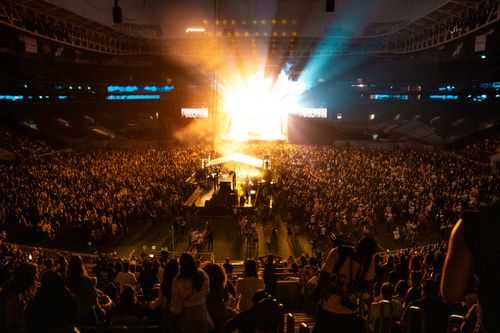
That brings us to the asset class actually appreciating: live touring. Bad Bunny's $96.1 million across ten shows — 623,000 tickets, the largest box-office report of 2026 and by a solo artist in history, per box-office tracker touringdata — and Coldplay's $464.9 million gross on Billboard's Top Tours put stadium circuits in the revenue territory of sovereign-scale events. Award shows now compete with these tours for the same sponsorship dollars, the same municipal goodwill and the same consumer discretionary wallet. The unseen inversion: the telecast is becoming the marketing funnel for the live asset, not the reverse. A VMA moment is worth what it does to ticket velocity and catalog streams; the trophy itself is a rounding error.
The Operator's Playbook
For event-adjacent businesses: build inventory around the non-local surge, not the resident regular — the 16.7 percent is your customer, and visitor-facing packaging (fan zones, watch parties, second-screen promotions around the Sept. 14 and Sept. 27 telecasts) is how it converts. For promoters and venue operators: lock Q4 arena dates now, because post-tour demand spills into every available roof. For taxpayers in any city eyeing a future bid: demand a published ex-post audit and a funded legacy vehicle before a single dollar is committed. For studios and labels: consolidate campaign spend behind one tentpole per window; in a compressed calendar, a diversified prestige portfolio is how you win nothing, everywhere.
Six Months Out
By February 2027, expect the Venice-to-Emmys pipeline to have set the Oscar field and confirmed Q4 compression as a permanent calendar fixture; two or three World Cup host cities to announce legacy foundations on the Dallas model while one or two quietly exit future bidding; and ticket-pricing scrutiny to migrate from press coverage into rulemaking as touring grosses keep compounding. September will be remembered not as a traffic jam but as the quarter the industry learned to price attention the way commodity traders price grain — by delivery month, not by harvest.
Related Articles

The Attention Arbitrage: Inside the Financial Restructuring of the Global Awards Economy
Aug 12, 2026
The Metabolic Enclosure: How FDA Compounding Bans and Biometric Telemetry are Rewiring Nutrition & Fitness Economics
Aug 12, 2026
Comments (0)
No comments yet. Be the first to share your thoughts!
Want to join the discussion?
Please log in to post a comment.
Login NoworCreate an Account