
The Magic Forest in the Classroom: American Schools Use Virtual Reality to Help Children Find Calm and Focus

The Magic Forest in the Classroom
Imagine your brain is a giant, busy airport. There are hundreds of little airplanes taking off and landing every single minute. These airplanes are your thoughts, your feelings, and the things you need to remember, like your spelling words or where you put your lunchbox. When the weather is sunny and the air traffic controllers are doing a good job, everything runs smoothly. The airplanes land safely, and you feel happy, calm, and ready to learn. But sometimes, a big, dark storm rolls in. The wind howls, the rain pours, and the airplanes start flying too fast, bumping into each other, and getting lost in the clouds. This is what it feels like when a child has anxiety or Attention Deficit Hyperactivity Disorder, which doctors call ADHD. The storm inside their head makes it very hard to sit still, very hard to listen to the teacher, and very hard to feel safe. For a long time, the only way to help these children was to give them medicine to slow the airplanes down, or to send them to a quiet room to talk about their feelings. But on a bright, hopeful Monday in late June 2026, the United States Department of Education, working together with brilliant scientists and child psychologists, announced a magnificent, magical new way to clear the storm. They are putting 'Magic Goggles' in thousands of elementary schools across the country. These goggles use Virtual Reality, or VR, to transport children into a peaceful, beautiful, and incredibly realistic forest, helping their brains learn how to calm down and find their focus again. Let us explore this wonderful, mind-healing mission, explaining the science of the brain and the magic of technology in a way that is as easy to understand as a bedtime story, but told with the deep, compassionate respect of a master medical journalist.
To understand why these Magic Goggles are so incredibly special, you first need to know how the brain reacts when it feels scared or overwhelmed. Deep inside your brain, there is a tiny, almond-shaped alarm bell called the amygdala. Its job is to keep you safe from danger. If it sees a scary dog or a fast-moving car, it rings loudly, telling your body to run away or freeze. This is called the 'fight or flight' response. But for children with anxiety, the amygdala is a little bit too sensitive. It rings loudly even when there is no real danger, like when the classroom gets too noisy, or when a math problem looks too hard. When the alarm rings, the body pumps out a chemical called cortisol, which makes the heart beat fast and the tummy feel tight. The child cannot learn when their body thinks it is running from a bear. The scientists realized that to help the child learn, they first had to turn off the alarm bell and tell the brain, 'You are safe. You are in a beautiful, quiet place.'
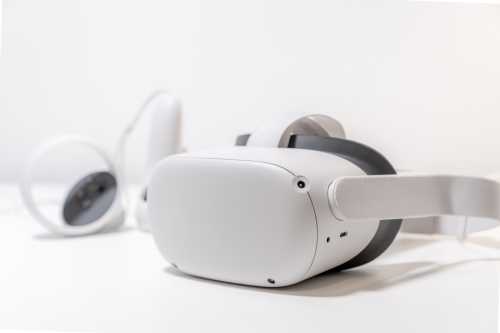
This is where the Magic Goggles come in. The program is called 'Project Green Mind.' The goggles look like a pair of thick, soft swimming masks that strap gently around the back of the head. But when the child puts them on, the noisy, bright, busy classroom completely disappears. Instead, the child is standing in the middle of a magnificent, ancient redwood forest. The trees are so tall they touch the sky, and the sunlight filters through the green leaves, making beautiful, dancing shadows on the forest floor. The child can look up, look down, and look all around, and everywhere they look, there is peace and nature. But it is not just a picture; it is a fully immersive, three-dimensional world. The goggles have tiny, hidden speakers that play the exact sounds of the forest: the gentle rustling of leaves, the distant call of a songbird, and the soft bubbling of a hidden creek. Some of the advanced goggles even have a tiny, quiet fan that blows a soft, cool breeze against the child's cheeks, making it feel exactly like a real walk in the woods.
But the magic does not stop at just looking at trees. The 'Project Green Mind' software is guided by a gentle, friendly voice that acts like a wise, invisible forest ranger. The ranger asks the child to take a deep breath in, imagining they are smelling a beautiful, sweet pinecone, and then to breathe out slowly, imagining they are blowing a dandelion puff into the wind. As the child breathes, the virtual forest reacts. When they breathe in, the virtual flowers bloom and open their bright petals. When they breathe out, the virtual leaves gently fall and float on the creek. This is called 'biofeedback.' It is a way of showing the child their own breathing on the outside, so they can see how their body controls the world around them. It teaches them that they have the power to calm the storm inside their head, simply by taking slow, deep breaths. It turns the scary, invisible feeling of anxiety into a beautiful, visible game that they can win.
To see the true magic of this program, let us talk about a wonderful nine-year-old boy named Leo who goes to a public school in Chicago. Leo has a very fast, very busy brain. He is incredibly smart and loves to build giant Lego castles, but sitting still in a classroom full of thirty other children felt like trying to hold a wild butterfly in his hands. His amygdala alarm bell was always ringing. He would get frustrated, his tummy would hurt, and he would sometimes hide under his desk because the noise of the school was too much for his sensitive ears. His teacher, Mrs. Gable, tried everything to help him, but she had to teach the whole class and could not always sit with Leo to calm him down. When 'Project Green Mind' arrived at his school, everything changed. Mrs. Gable created a special 'Calm Corner' in the room with a soft beanbag chair and the Magic Goggles.
One Tuesday, when the classroom was loud and Leo felt the storm clouds gathering in his head, he asked to go to the Calm Corner. He sat on the beanbag and put on the soft goggles. Instantly, the noisy classroom vanished. He was in the redwood forest. He heard the gentle voice of the forest ranger telling him to smell the pinecone and blow the dandelion. Leo took a deep breath, and watched a giant, beautiful virtual flower bloom right in front of his eyes. He breathed out, and watched a golden leaf float down the stream. He did this for just ten minutes. When he took the goggles off, the storm in his head had passed. The airplanes in his brain were landing safely again. He walked back to his desk, picked up his pencil, and finished his math worksheet with a calm, focused mind. Mrs. Gable was amazed. She said it was like watching a tight, tangled knot magically untie itself in just a few minutes.
The science behind why the forest works so well is deeply rooted in human history. For millions of years, human beings lived outside, surrounded by trees, rivers, and animals. Our brains are literally wired to feel safe and relaxed when we see nature. Scientists call this 'Biophilia.' When we look at the fractal patterns of tree branches or the gentle flow of water, our brain releases happy, calming chemicals like serotonin and dopamine. But today, most children spend their entire day inside concrete buildings, staring at flat, glowing screens. Their brains are starved for nature, which makes the anxiety and the busy thoughts much worse. By bringing the forest directly into the classroom through the Magic Goggles, the scientists are giving the children's brains the exact medicine they have been missing. It is like giving a thirsty plant a long, cool drink of water.
The American Psychological Association has been closely tracking the results of 'Project Green Mind' in over five hundred pilot schools. The data is absolutely breathtaking. Schools report that disciplinary problems have dropped by half, because children are learning how to regulate their own emotions before they get angry or upset. Test scores in reading and math have gone up, because a calm brain is a learning brain. But the most beautiful result is what the children themselves are saying. They are learning the vocabulary of their own minds. They are learning to say, 'My alarm bell is ringing, I need to visit the forest,' instead of acting out or crying. They are becoming the masters of their own mental health, building tools that they will carry with them for the rest of their lives.
The government has pledged billions of dollars to ensure that every single public school in the United States has access to the Magic Goggles by the end of the year. They are also training teachers on how to use the technology, not as a toy or a reward, but as a vital medical and emotional tool. The goggles are built with strict privacy rules; they do not record the child's face or track their eyes for advertising. They are purely a safe, enclosed sanctuary for the mind. The engineers who built them worked closely with children who have autism, ADHD, and severe anxiety to make sure the headset is comfortable, the lights are not too bright, and the sounds are soothing, not overwhelming.
As the summer of 2026 turns into autumn, thousands of children will return to school, not with fear in their tummies, but with the knowledge that they have a secret, magical forest waiting for them whenever they need it. 'Project Green Mind' is a shining example of how technology, which is often blamed for making us more distracted and anxious, can actually be used to heal us, to ground us, and to bring us back to nature. It is a beautiful, enduring story of innovation, of compassion, and of the wonderful truth that sometimes, the best way to fix the busy, modern world is to put on a pair of goggles and take a quiet walk in the woods.
A monumental day for children's mental health! ???????? 'Project Green Mind' is bringing VR nature sanctuaries to 10,000 US schools, giving kids the tools to calm their minds and find their focus. The future of education is compassionate! ????♂️✨ #ProjectGreenMind#MentalHealth
— Child Mind Institute (@ChildMindInst) June 29, 2026
Related Articles

The $111 Billion Freeze: How the Paramount-WBD Merger Gridlock is Rewiring Global Sports Media
Aug 13, 2026
The Velvet Rope of the Analog Age: Why Nantucket's 'No Influencers' Sign Signals the End of Spatial Arbitrage
Aug 13, 2026
Comments (0)
No comments yet. Be the first to share your thoughts!
Want to join the discussion?
Please log in to post a comment.
Login NoworCreate an Account