
The Synthetic Cartel: How AI Enclosure and Antitrust Balkanization are Rezoning the Music Economy


The Five-Front Siege on the Music Monopoly
In maritime logistics, when a canal authority dredges a new channel, they dictate the tariff rates for every vessel; in the music industry, the gatekeepers have simply decided to own the ships, the water, and the cargo. Over the past quarter, the global music syndicate has faced a synchronized, five-front siege that is fundamentally rewiring its unit economics: a jury found Live Nation guilty of antitrust violations in primary ticketing, the RIAA escalated its copyright war against AI generators Suno and Udio, UMG and TikTok codified a new AI-attribution licensing framework, a wave of mid-tier music festivals entered liquidation, and streaming payouts stagnated at a fraction of a cent. These are not isolated market corrections; they represent the total financialization of sonic real estate and the collapse of the independent distribution pipeline.
The Algorithmic Enclosure and the Death of the Middle Class
Mainstream media frames the April 2026 jury verdict against Live Nation as a triumph for consumer rights, ignoring the deeper structural shift in live event syndication. The jury definitively found that "Live Nation had violated the antitrust laws through the use of its monopoly power in the primary ticketing" sector [[7]]. However, the Department of Justice quietly settled mid-trial, leaving the states to push for broader relief [[4]]. This bifurcated legal outcome does not dismantle the monopoly; it merely shifts the regulatory burden to a fragmented patchwork of state attorneys general, effectively Balkanizing the touring economy. The unseen impact is the acceleration of vertical integration: rather than divesting Ticketmaster, Live Nation will absorb the regulatory fines as a sunk cost, raising venue exclusivity premiums and squeezing independent promoters out of the routing matrix entirely.
The Illusion of Market Correction
It is analytically convenient to assume that state-level antitrust victories will naturally dismantle the live entertainment monopoly and restore competitive pricing for consumers. However, this perspective ignores the sheer capital density required to operate a global ticketing and venue infrastructure. The regulatory fragmentation will likely increase compliance costs, which will be passed directly to the consumer through newly invented "compliance and routing" fees, effectively masking the monopoly premium under the guise of statutory mandates.
The Synthetic Licensing Cartel
Simultaneously, the intellectual property layer is being enclosed by a synthetic licensing cartel. "The RIAA v. Suno and Udio lawsuit is the defining AI music copyright fight of 2026," as labels attempt to block models trained on over 61,000 copyrighted recordings [[10], [11]]. Yet, Universal Music Group is simultaneously striking multi-year strategic deals with platforms like TikTok to monetize and remove unauthorized AI-generated music [[19], [22]]. This dual strategy reveals the true objective: the legacy labels are not fighting to destroy generative AI; they are fighting to own the underlying training data and establish a monopsony royalty collection framework for synthetic derivatives. By securing AI attribution protections, UMG and TikTok are effectively building a walled garden where only state-sanctioned synthetic music thrives, pricing out independent creators who cannot afford the enterprise API access required to generate compliant audio.
Echoes of ASCAP and the Radio Boycott of 1941
To understand the terminal trajectory of this IP enclosure, one must examine the ASCAP radio boycott of 1941. When the American Society of Composers, Authors and Publishers attempted to double their licensing fees, the major radio networks simply refused to broadcast ASCAP music for ten months, instead forming BMI to represent the marginalized genres of country, R&B, and folk. The lesson from 1941 is that when legacy IP holders price their catalog out of the dominant distribution medium, the market will ruthlessly engineer an alternative supply chain. Today’s tech conglomerates and AI startups are currently building the BMI of the 21st century, training models on public domain and independent catalogs to bypass the major label syndicate entirely.
The Liquidity Crunch of the Festival Circuit
The liquidity crunch is now manifesting in the physical collapse of the mid-tier festival circuit and the stagnation of streaming royalties. In 2026, the music festival cancellation rate has surged, with dozens of events like the Hot August Music Festival and 4 Peaks shutting down due to consolidation and insurmountable insurance premiums [[38], [39]]. Concurrently, "In 2026, the average Spotify royalty payout per stream remains around $0.004," rendering the traditional album-release cycle mathematically insolvent for the middle class of musicians [[27]]. The liquidation of mid-market festivals is not merely a logistical failure; it is a deliberate market clearing event engineered by the duopoly to absorb distressed assets at pennies on the dollar. This dual squeeze is forcing artists to abandon the traditional touring-and-streaming model entirely, pivoting toward high-margin, direct-to-fan digital ecosystems where the physical live event is merely a loss-leader for exclusive community subscriptions.
The Democratization of the Synthetic Toolset
Conversely, framing the AI revolution purely as a corporate extraction mechanism ignores the profound democratization of high-end production for independent musicians. The same generative tools that the RIAA is fighting to regulate are currently allowing micro-budget artists to produce complex, multi-instrumental arrangements that would have required expensive studio time a decade ago. By reducing the barrier to entry for sonic composition, AI is fostering a new renaissance of independent music that bypasses traditional label gatekeepers, proving that the technology is a neutral amplifier of creativity, not inherently a tool of monopolistic suppression.
Tactical Maneuvers for the Independent Operator
For independent labels, regional promoters, and mid-tier artists, the immediate directive is to decouple from the algorithmic slot machine and pivot toward verifiable, un-optimizable physical scarcity. You cannot out-spend Live Nation for routing priority, nor can you out-stream a synthetic AI playlist. Instead, regional operators must engineer hyper-local, interactive live experiences that rely on physical proximity and community trust, utilizing token-gated ticketing to prevent secondary market scalping. Local venues must also renegotiate their beverage and merchandising contracts to ensure that the ancillary revenue streams remain insulated from the primary ticketing monopolies, effectively building a financial moat around the physical fan experience. Furthermore, independent artists must aggressively audit their digital supply chains, utilizing direct-to-fan platforms to capture the full margin of their core audience, treating Spotify and TikTok purely as top-of-funnel discovery engines rather than primary revenue sources.
The Q1 2027 Repricing of Sonic Real Estate
In six months, as we enter the first quarter of 2027, the music landscape will face a severe repricing of sonic real estate and a violent correction in live event insurance. We will witness the first major acquisition where a tech conglomerate purchases a legacy independent label specifically to secure its catalog as proprietary training data for a closed-loop generative audio model. Simultaneously, the mid-tier festival market will experience a wave of bankruptcies, forcing regional municipalities to subsidize local music events as essential cultural infrastructure to prevent total market consolidation by the Live Nation/AEG duopoly. The entities that fail to recognize that the zoning laws of music have permanently changed will find themselves holding depreciating streaming assets in a synthetic economy.
Related Articles

The $12 Billion Zoning Grab: How the Lakers Mega-Deal and the NCAA Shadow Cap Are Rewiring Sports Capital
Aug 14, 2026
The Architecture of Attrition: Regulatory Convergence and the Institutional Securitization of the Global Sports Matrix
Aug 14, 2026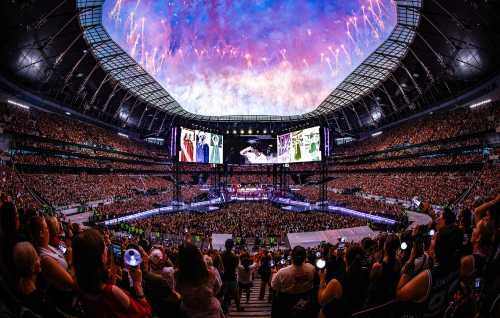
Comments (0)
No comments yet. Be the first to share your thoughts!
Want to join the discussion?
Please log in to post a comment.
Login NoworCreate an Account