
Music Industry's October Reckoning: Lawsuits, AI Flood, and Market Collapse Signal Structural Crisis

Like a dam developing multiple hairline fractures before the structural failure becomes visible, the music industry spent October 2026 watching pressure points give way simultaneously—litigation, market valuation collapse, and technological disruption converging in ways that suggest the streaming era's foundation is less stable than quarterly reports indicated.
The Legal Barrage and Market Reality
Universal Music Group filed suit against distributor DistroKid in September, accusing the platform of "flooding streaming services with mass AI-generated, SEO-optimized, and copyright-infringing slop" that diverts royalties from legitimate artists [[46]]. DistroKid has responded by quietly removing tracks, extending response deadlines, and facing backlash from independent artists who claim collateral damage [[48]][[49]].
Warner Music Group simultaneously pursued a $64 million copyright infringement case against EssilorLuxottica, the parent company of Ray-Ban and Oakley, alleging unauthorized use of 427 copyrighted works in social media promotional content [[50]][[51]]. The lawsuit exposes a fundamental tension: brands treating social media as a copyright-free zone while rights holders demand compensation for commercial exploitation.
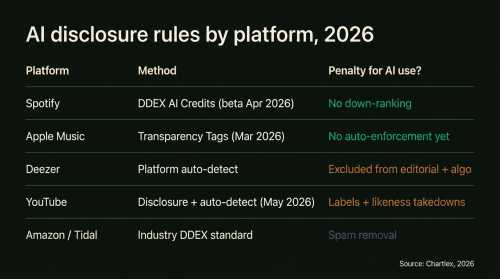
Deezer announced users can now completely exclude AI-generated music from search results, acknowledging that AI tracks represent over 50% of daily uploads at peak levels in June 2026 [[61]][[65]]. The streaming platform has detected and tagged over 13.4 million AI-generated tracks, setting what it claims as an industry standard for transparency [[95]].
The Stock Market Verdict
Investors delivered a harsh assessment: Universal Music Group stock plummeted 35% year-to-date, trading at 14.27 euros, while Spotify declined 15% [[68]]. Music companies face what analysts describe as "crosswinds"—simultaneous pressure from streaming saturation, AI disruption, and catalog valuation uncertainty [[68]].
Yet global recorded music revenues reached $31.7 billion in 2025, representing 6.4% growth and marking eleven consecutive years of expansion [[73]]. This paradox—strong fundamentals but collapsing equity valuations—reveals investor anxiety about whether current revenue models can survive the AI onslaught.
The Napster Parallel and What It Teaches
RIAA Chairman and CEO Mitch Glazier recently stated: "I hope that the [music] industry never gets into a shape again where it ever sues users" [[128]]. The comment reflects institutional memory of the Napster era, when litigation against consumers created lasting reputational damage while failing to halt technological disruption.
Today's lawsuits target intermediaries—distributors and brands—rather than end users, representing a tactical evolution. However, the strategic challenge remains identical: legal enforcement cannot outpace technological capability. The Napster precedent demonstrates that industries which focus exclusively on litigation while neglecting product innovation cede market relevance.
The Invisible Infrastructure Crisis
Beneath the headlines lies a more pernicious problem: the economics of music catalog valuation are destabilizing. Music catalog acquisitions totaled nearly $13 billion in 2025 across 566 transactions [[114]]. These valuations assumed streaming revenue would continue growing predictably, providing stable income streams for decades.
AI-generated content threatens this assumption at its core. When 44% of uploaded tracks are AI-generated, and when those tracks compete for the same streaming dollars as human-created music, the revenue pool becomes diluted [[60]]. Catalog buyers paid premium multiples based on historical performance that may not extrapolate forward.
The RIAA's endorsement of the NO FAKES Act represents recognition that voice and likeness protection requires legislative intervention [[82]]. Ninety-two percent of music creators support stricter laws preventing AI from using someone's voice, image, or likeness without permission [[80]]. This consensus suggests the industry views AI impersonation as an existential threat requiring regulatory solutions beyond copyright law.
The Independent Artist Dilemma
DistroKid's track removals expose a structural vulnerability in the independent music ecosystem. The distributor serves artists who lack the legal resources to contest wrongful takedowns or navigate complex copyright disputes. When UMG alleges "deceptive business practices," independent artists face account suspensions and revenue loss regardless of individual culpability [[45]].
Independent artists now control approximately 40% of streaming revenue, representing a significant shift in market dynamics [[111]]. However, this demographic faces disproportionate risk from AI competition and platform policy changes. The most successful independent artists in 2026 diversify across four to six income streams, generating 2-4 times the income of those relying solely on streaming [[91]][[103]].
Counter-Argument: The Compliance Theater Trap
Critics argue that Deezer's AI filtering and the RIAA's legislative lobbying represent performative measures that address symptoms rather than causes. AI detection tools face fundamental accuracy limitations, with technologists like Benn Jordan demonstrating that detection algorithms struggle to distinguish sophisticated AI music from human production [[99]].
Furthermore, the focus on "fully AI-generated" content ignores the hybrid reality of modern music production. AI tools now assist with stem separation, mix balancing, harmony generation, and composition—functions that survey data shows most producers accept as legitimate workflow enhancements [[31]]. Drawing a bright line between acceptable AI assistance and prohibited AI generation proves increasingly arbitrary as tools become more sophisticated.
Counter-Argument: The Sovereignty Imperative
An alternative perspective suggests that major labels' aggressive litigation strategy reflects rational self-preservation rather than obstructionism. Warner Music's $64 million lawsuit against EssilorLuxottica targets commercial entities that profited from copyrighted works without licensing—a straightforward enforcement of property rights [[50]].
The streaming model already compressed per-stream payouts to $0.002-$0.015, making royalty protection essential for artist sustainability [[108]]. If brands can use music freely in promotional content and if AI-generated tracks can siphon streaming revenue without accountability, the economic foundation supporting professional music creation collapses. Legal enforcement, while imperfect, remains necessary to maintain market discipline.
Strategic Imperatives for Market Participants
For independent artists: Diversify revenue streams immediately. Sync licensing, live performance, merchandise, and direct fan support provide insulation against streaming volatility. Artists working in Los Angeles and other major markets report success combining traditional recording with content creation and brand partnerships [[107]].
For catalog investors: Recalculate valuation multiples accounting for AI competition risk. The 12-14x multiples common in 2025 may not reflect 2026-2027 revenue reality [[112]]. Prioritize catalogs with strong sync licensing potential and cultural permanence over trending genres vulnerable to AI replication.
For brands and advertisers: Implement rigorous music clearance protocols. The Warner-EssilorLuxottica litigation demonstrates that social media posts constitute commercial use requiring licensing [[53]]. Budget for music rights as a line item rather than treating it as an afterthought.
Six-Month Trajectory Forecast
By April 2027, expect three structural shifts: First, additional distributors will implement AI content policies resembling Deezer's framework, creating a fragmented compliance landscape that disadvantages independent artists lacking legal counsel. Second, music catalog M&A will slow as buyers demand lower multiples reflecting AI competition risk. Third, the NO FAKES Act or similar legislation will advance, establishing federal protections against AI voice and likeness replication.
The streaming market, valued at $62.5 billion in 2026 and projected to reach $158.1 billion by 2033, will experience growing pains as it transitions from growth-at-all-costs to sustainable economics [[93]]. Companies that adapt to hybrid human-AI production workflows while maintaining authentic artist-fan connections will outperform those clinging to either pure traditionalism or unchecked AI adoption.
The music industry's October 2026 crisis mirrors previous technological disruptions—not because the challenges are insurmountable, but because institutional inertia delays adaptation until market forces make it unavoidable. The question is not whether the industry will survive AI, but which participants will navigate the transition with their business models intact.
Related Articles
Music Industry's October Reckoning: AI Flood, Legal Onslaught, and the Redistribution of Power
Oct 13, 2026
The Synthetic Squeeze: How Licensed AI Training and Catalog Securitization Are Rewriting the Economics of Recorded Music
Oct 13, 2026
Comments (0)
No comments yet. Be the first to share your thoughts!
Want to join the discussion?
Please log in to post a comment.
Login NoworCreate an Account