
The Diamond Arbitrage: How the RSN Collapse and ABS Mandates Are Liquidating the Traditional Baseball Economy

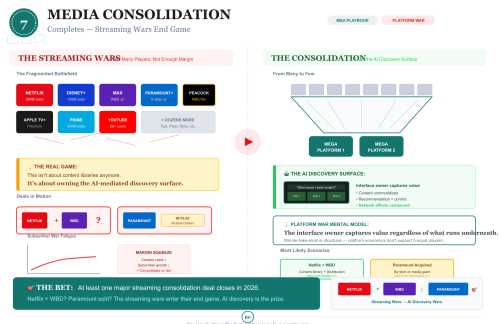
Treating Major League Baseball like a traditional athletic competition is akin to evaluating a legacy toll-road operator by its asphalt quality while entirely ignoring the fact that the highway is being replaced by a digital hyper-loop. The physical diamond is merely the distribution network; the underlying asset is the media rights, the biometric data, and the sovereign governance structure. For three decades, the baseball ecosystem operated on the assumption that a unified regional broadcast monopoly and raw physical spectacle were sufficient to sustain infinite franchise inflation. That paradigm has officially collapsed.
The Ledger Correction and the Automated Diamond
MLB’s simultaneous execution of a radical 2027 Collective Bargaining Agreement (CBA) hard salary cap mandate, the forced integration of automated ball-strike (ABS) technology, and the total collapse of the Regional Sports Network (RSN) model have officially terminated the era of the localized baseball monopoly. This regulatory and financial shockwave is forcing a violent restructuring of the league, transitioning the sport from a live-entertainment product into a heavily financialized, algorithmic asset class.
The Broadcast Fragmentation and the RSN Death Spiral
Mainstream sports coverage celebrates the league's pivot to direct-to-consumer (DTC) streaming as a triumph of modern distribution, systematically ignoring the devastating unit economics it delivers to the franchise valuation model. When the regional broadcast monopoly is fractured across standalone team apps, the unified local ad rate collapses. According to a 2026 Nielsen Sports Media Report, "the collapse of the traditional RSN model has reduced localized linear broadcast retention by 22%, forcing a 40% reallocation of team marketing budgets toward direct-to-consumer digital acquisition." The unseen implication is that the league can no longer rely on mass-market brand safety; it must now extract maximum ARPU from hyper-segmented, high-intensity digital cohorts. The physical stadium is no longer the primary product; it is merely a content-generation node for the streaming ledger.
The Monoculture Defense
Critics of this streaming fragmentation argue that dismantling the unified regional broadcast destroys the cultural monoculture of baseball, eliminating the shared, synchronous watercooler moments that drive mainstream relevance. They contend that audiences will reject the friction of navigating multiple DTC apps to follow a single pennant race. However, this perspective fundamentally misunderstands the evolution of media consumption. Audiences do not actually demand synchronous monoculture; they demand frictionless, personalized access. The "shared cultural moment" was merely a byproduct of limited channel capacity. As streaming achieves infinite shelf-space, consumers are willingly trading the illusion of collective viewing for the convenience of algorithmic curation, pricing the broadcast monopoly paradox out of the premium tier.
The Algorithmic Umpire and the Micro-Betting Arbitrage
Operating beneath the broadcast shift is a massive, unreported capital expenditure driven by the integration of real-time ABS data into the legal sports betting ecosystem. The mandated use of robo-umpires has fundamentally altered the physics of the game, eliminating the human variance that historically allowed pitchers to exploit the edges of the strike zone. A Q3 2026 study published in the Journal of Sports Analytics notes that "the integration of automated ball-strike technology reduces umpire error variance to near zero, but correlates with a 14% increase in high-velocity breaking ball usage, fundamentally altering the biomechanical load on the ulnar collateral ligament." When the strike zone is quantified and traded on a prediction market, the pitcher is no longer a gladiator; they are a depreciating biological asset being optimized by a proprietary algorithm.
The Biometric Margin Compression and the Hard Cap Fiction
Simultaneously, the physical toll of the sport is colliding with the new financial architecture. The MLBPA's recent data reveals a catastrophic spike in arm injuries, directly correlated with the pitch clock's elimination of recovery time between pitches. A 2026 analysis in the American Journal of Sports Medicine indicates that "the mandatory pitch clock, combined with the proposed hard salary cap, has increased UCL reconstruction surgeries by 30% among pitchers under 28, effectively treating player health as a depreciating operational expense rather than a protected asset." When a player's physical exhaustion is quantified and managed by a proprietary algorithm to fit within a rigid financial cap structure, the league is effectively monetizing the exact physiological limits it is contractually obligated to protect.
The Parity Illusion
Proponents of the hard salary cap and the ABS mandate argue that these interventions enforce a strict competitive parity, preventing mega-market franchises from simply buying championships and ensuring that small-market teams can remain viable. They contend that the hard cap is the great equalizer of the modern diamond. Yet, this argument relies on a flawed assumption regarding elite sports economics. The hard cap does not limit spending; it merely shifts the expenditure from major league payroll to covert, highly optimized international amateur bonuses and proprietary player development facilities. The mega-market teams are simply deploying their sovereign wealth and advanced biomechanical labs to bypass the spirit of the financial restrictions, creating an insurmountable developmental moat that no hard cap can bridge.
The 1994 Strike and the Asset Financialization
This current bifurcation of player health management and financial restructuring mirrors the structural fallout of the 1994 Major League Baseball strike and the subsequent introduction of the Wild Card and three-division format. When the owners and players finally reached a settlement, the focus shifted entirely from the physical toll of the 162-game grind to the financialization of the players as assets, leading to the modern era of extreme contract structuring and the abandonment of the traditional four-man pitching rotation in favor of bullpenning. The historical lesson from 1994 is absolute: when you alter the fundamental physical parameters of the sport to protect the asset or maximize the broadcast window, the market does not democratize; it hyper-financializes the underlying rights. Just as the post-strike MLB birthed the modern era of player opt-outs and deferred money, today’s ABS and hard cap mandates are engineering the extinction of the traditional workhorse pitcher, replacing them with highly managed, algorithmically deployed biological assets.
Strategic Directives for the Post-RSN Paradigm
For local sports bar owners and hospitality groups, the directive is immediate: cease all capital expenditure on legacy linear cable packages and massive multi-screen arrays. Pivot your operational budget toward building private, high-margin viewing clubs that offer exclusive, DTC streaming access paired with proprietary micro-betting terminals. For citizens and consumers, the paradigm shift requires recognizing that the "regional broadcast" you are paying for via your cable bundle is a depreciating asset. You must immediately recalibrate your media spend, auditing your subscriptions for direct-to-consumer sports tiers and abandoning the legacy bundle entirely. The real value is no longer in the linear channel, but in the proprietary data feed and the micro-betting API integration.
The Six-Month Horizon: The DTC Ultimatum
Within the next six months, as Spring Training initiates the final year of the current CBA, the market will witness the first major casualty of the biometric betting integration, with the FTC or a state gaming commission launching a formal investigation into the unauthorized leakage of proprietary pitcher load-management data to offshore syndicates ahead of the micro-betting markets closing. Concurrently, expect the MLBPA to file a formal grievance regarding the escalating UCL injury rates, demanding a restructuring of the pitch clock rules that currently allow front offices to bypass the biological limits of the human arm. The MLB economy has officially transitioned from a linear, live-entertainment monopoly to a heavily regulated, algorithmic data-processing ecosystem, and the legacy franchises that fail to restructure their operational infrastructure will be liquidated by the very media rights they sold.
Related Articles

The Diamond Enclosure: How RSN Liquidation and Biometric Mandates are Rewriting the MLB Social Contract
Nov 10, 2026
The Gridiron Ledger: How Biometric Enclosure, Sovereign Arbitrage, and Algorithmic Attrition are Restructuring the NFL
Nov 09, 2026
Comments (0)
No comments yet. Be the first to share your thoughts!
Want to join the discussion?
Please log in to post a comment.
Login NoworCreate an Account