
Jon Hamm's Paternity Pivot at 55: Why a Resurfaced 2012 Quip Is Really a Story About Celebrity Archive Risk

In equity research there is a familiar moment when a company that spent a decade buying back its own stock suddenly announces a dividend: analysts stop pricing the past and reprice the future. Celebrity careers have the same tell, and this week it fired on a 55-year-old actor who spent twenty years playing fathers on television.
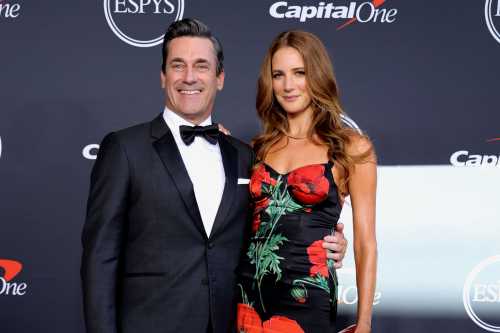
Jon Hamm and wife Anna Osceola, 38, are expecting their first child, People confirmed, closing a narrative arc that began when Hamm told Howard Stern in 2022 that Osceola "opened up the possibility of things like being married, having kids, defining a new version of happiness." Within hours of the pregnancy news, Page Six and Us Weekly resurrected his March 2012 line to Us Weekly, "I'd be a terrible father!", converting a fourteen-year-old comedy beat into the week's highest-yield celebrity contradiction.
The Archive Is Now a Liability Class
The first unseen implication is that the resurfaced quote is not journalism's discovery but the attention market's predictable harvest. Every public statement now carries a reputational duration, and Hamm's 2012 file was always going to reprice the day his family status changed. PR operations must now audit fifteen searchable years of client tape the way banks stress-test legacy loan books, because the contradiction-between-then-and-now format is the cheapest engagement product in celebrity media.
The second implication sits in the fertility economy. Federal vital statistics have documented a steady rise in the share of births to fathers over fifty across the past three decades, and each high-profile late fatherhood story functions as unpaid category marketing for sperm banking, IVF clinics and longevity wellness. Hamm's Stern quote, with its talk of "a new version of happiness, life, wellness," reads like copy written for that industry, and expect the wellness-adjacent endorsement mix to follow the baby, not the other way around.
The third is endorsement repositioning. The family-man pivot reliably rotates a male star's category portfolio from spirits and grooming toward insurance, automotive, financial planning and legacy products, a migration that commands longer contract terms and lower scandal risk premiums. For a star headlining Apple TV's prestige slate, the pregnancy is a balance-sheet event, not a gossip item.
Against the Outrage Arbitrage
Two corrections are warranted. First, the 2012 remark was a self-deprecating bit delivered in a different life stage, alongside Jennifer Westfeldt's candid and equally contextual reflection that "the chance that we'll regret it doesn't seem like a compelling enough reason to do it." Treating banter as confession is manufactured arbitrage, not analysis. Second, the couple's restraint, marrying quietly and avoiding overshare, is itself an asset class: scarcity historically converts into seven-figure exclusive fees when the family finally chooses to speak.
The Clooney Precedent
George Clooney became a first-time father at 56 in 2017, and the episode remains the controlling precedent: handled with privacy and dry humour, late fatherhood compounded his elder-statesman equity rather than diluting it, and his brand portfolio widened into media ownership and philanthropic capital. The lesson for Hamm is precise, that the market rewards late paternity when it is framed as chapter two of a deliberate life, and punishes only those who over-narrate it.
Practical Moves While the Story Is Hot
- PR and reputation firms should productise archive audits for talent, pricing the resurfacing risk before the market does.
- Family-category brands should negotiate after the birth announcement, when the storyline converts from speculation to portrait.
- Consumers should timestamp every resurfaced quote; context is the cheapest fact-check available.
February 2027: The Controlled Reveal
Six months out, expect a single controlled family portrait exclusive, one or two legacy-category endorsement additions, and an awards-season narrative that folds Hamm's real-life chapter into his on-screen prestige. The quip that resurfaced this week will by then have been fully absorbed, proof that in the modern celebrity economy even a contradiction is an asset, provided someone is managing the duration.
Primary sources:Page Six report · People confirmation · Yahoo Entertainment video coverage
Related Articles

Sabrina Ionescu Stays: The Liberty Re-Signing Is the WNBA's Star-Economy Maturity Test
Aug 14, 2026
The Kennedy Center Name Vote Is a Corporate Governance Story Wearing a Culture-War Costume
Aug 14, 2026
Comments (0)
No comments yet. Be the first to share your thoughts!
Want to join the discussion?
Please log in to post a comment.
Login NoworCreate an Account