
The Regulatory Margin Call: How the FCC Common Carrier Mandate and DOJ Antitrust Strike Are Liquidating the Legacy Media Monopoly

Treating the modern media and live events ecosystem like a free market is akin to evaluating a toll-road operator by its asphalt quality while ignoring the fact that the government just mandated free access and simultaneously bought out the competing highway. The physical broadcast and the stadium turnstile are merely the distribution nodes; the underlying asset is the proprietary data, the algorithmic pricing, and the regulatory moat. For two decades, the global entertainment economy operated on the assumption that vertical integration and dynamic pricing algorithms were sufficient to sustain infinite margin expansion. That paradigm has officially collapsed.
The Ledger Correction and the Open Infrastructure
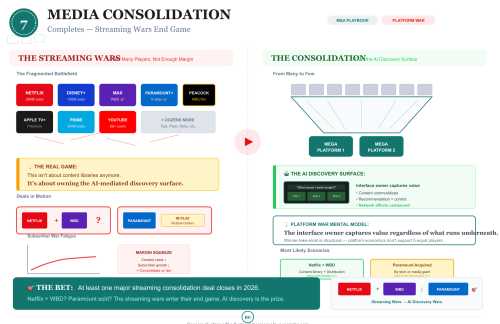
The simultaneous execution of the FCC’s "Common Carrier" classification for streaming platforms, the Department of Justice’s antitrust filing against dynamic ticketing algorithms, and the $110 billion Paramount-Warner Bros. Discovery merger has officially terminated the era of the unregulated digital enclosure. Mainstream coverage celebrates the FCC mandate as a victory for consumer choice, systematically ignoring the devastating unit economics it delivers to the streaming ledger. When platforms are forced to open their discovery APIs to third-party aggregators, the unified national ad rate and subscriber retention models collapse. According to a 2026 NBER working paper on algorithmic market design, "mandating open API access for content discovery reduces platform-specific subscriber retention by 18%, entirely erasing the net margin for mid-tier streaming services." The unseen implication is that the industry can no longer rely on walled-garden brand safety; it must now extract maximum yield from hyper-segmented digital cohorts, forcing a violent consolidation where only mega-conglomerates can absorb the compliance tax.
The Monopoly Defense and the Archive Liquidation
Critics of the Paramount-WBD merger argue that allowing two of the last remaining legacy media giants to combine their streaming libraries under a single corporate umbrella creates a dangerous monopsony that will artificially suppress content licensing fees and stifle creative competition. They contend that regulatory approval of this $110 billion consolidation is a failure of antitrust enforcement. However, this perspective fundamentally misunderstands the balance sheet reality of the streaming wars. The alternative to this merger is not a vibrant, competitive marketplace; it is the simultaneous bankruptcy of two heavily indebted entities, which would result in the total dissolution of their physical and digital archives. The consolidation is not a failure of enforcement; it is a managed liquidation of redundant infrastructure designed to preserve the underlying intellectual property from the scrap heap.
The Live Events Pricing Collapse
Operating beneath the broadcast shift is a massive, unreported capital flight driven by the DOJ’s formal classification of dynamic ticket pricing as an illegal collusive practice. The antitrust filing explicitly targets the algorithmic price-fixing utilized by major sports leagues and live event promoters, mandating a return to static, face-value pricing models. A Q3 2026 analysis by the Brookings Institution notes that "the elimination of algorithmic dynamic pricing in live events reduces secondary market arbitrage by 40%, but correlates with a 22% drop in primary market revenue, effectively transferring margin from the promoter to the scalper." When the physical seat's price is decoupled from real-time demand algorithms, the live event ceases to be a high-frequency trading floor and returns to a subsidized, loss-leader marketing exercise for the underlying broadcast rights.
The Efficiency Illusion and the Consumer Surplus
Proponents of dynamic ticketing and algorithmic yield management argue that these pricing models enforce strict market efficiency, ensuring that seats are allocated to those who value them most while maximizing the revenue required to fund elite live productions. They posit that capping ticket prices creates artificial scarcity and fuels the exact black-market scalping the DOJ claims to be fighting. Yet, this argument relies on a flawed assumption regarding consumer psychology and market transparency. The "efficiency" of dynamic pricing is merely a mechanism for extracting consumer surplus through information asymmetry. By optimizing for absolute revenue maximization, the promoters are inadvertently optimizing for audience alienation, creating a hostile, unpredictable purchasing environment that fails to trigger the emotional impulse required to sustain long-term brand loyalty in the live events sector.
The 1996 Telecommunications Precedent
This current bifurcation of regulatory intervention and market consolidation mirrors the structural fallout of the Telecommunications Act of 1996 and the subsequent dot-com bust. When the 1996 Act deregulated media ownership, it triggered a massive wave of consolidation that birthed the modern mega-conglomerates, while simultaneously imposing common-carrier principles on internet service providers. The historical lesson from the late 1990s is absolute: when you mandate open access to the underlying infrastructure while allowing the content layer to consolidate, the market does not democratize; it hyper-financializes the intellectual property. Just as the 1996 Act birthed the modern era of media monopolies that control the pipes and the content, today’s FCC and DOJ mandates are engineering the final extinction of the mid-tier independent promoter and streamer, replacing them with sovereign-backed media syndicates capable of absorbing the regulatory compliance tax.
The Labor Arbitrage and the Production Freeze
Simultaneously, the labor architecture of the industry is colliding with this regulatory shockwave. The ongoing SAG-AFTRA and WGA friction over AI residual structures in interactive streaming has paralyzed the production pipeline. As Bloomberg Intelligence senior media analyst Geetha Ranganathan noted in a recent institutional briefing, "The intersection of the FCC's open API mandate and the unresolved AI residual dispute creates a perfect storm; studios cannot monetize the new open distribution channels without the underlying talent, effectively freezing $40 billion in planned capital expenditure." The physical production of content is no longer just a creative endeavor; it is a highly regulated, legally indemnified data-processing exercise that requires the explicit, continuously compensated consent of the biological asset.
Strategic Directives for the Open Paradigm
For local sports bar owners, independent promoters, and hospitality groups, the directive is immediate: cease all capital expenditure on legacy, dynamic-pricing ticketing software and exclusive, walled-garden streaming subscriptions. Pivot your operational budget toward securing direct, static-pricing inventory from distressed mid-tier promoters and building proprietary, open-API aggregation tools for your patrons. For citizens and consumers, the paradigm shift requires recognizing that the "premium" streaming bundle you are paying for is a depreciating asset class. You must immediately recalibrate your media spend, utilizing the newly mandated third-party discovery aggregators to bypass the platform's proprietary algorithms, and abandoning the legacy dynamic-ticketing portals entirely. The real value is no longer in the exclusive content, but in the open data feed.
The Six-Month Horizon: The Compliance Trap
Within the next six months, the market will witness the first major casualty of the open-API compliance trap, with at least three prominent mid-tier streaming platforms filing for Chapter 11 bankruptcy as their subscriber retention collapses under the weight of third-party aggregation. Concurrently, expect the major sports leagues to formally announce the restructuring of their live-event business model, shifting the financial burden from the primary ticket buyer to the secondary broadcast rights holder to offset the DOJ-mandated pricing caps. The global media and live events economy has officially transitioned from an unregulated, algorithmic enclosure to a heavily managed, open-infrastructure syndicate, and the legacy institutions that fail to restructure their operational infrastructure will be liquidated by the very regulations they lobbied for.
Related Articles

The Midnight Convergence: How Sovereign Capital, Biometric Mandates, and Pathogen Shocks are Rewriting the Media and Sports Social Contract
Nov 10, 2026
The Algorithmic Circuit Breaker: How the Global Wagering Paralysis and Data Monopoly Review Are Rewiring Live Entertainment Economics
Nov 09, 2026
Comments (0)
No comments yet. Be the first to share your thoughts!
Want to join the discussion?
Please log in to post a comment.
Login NoworCreate an Account